
Water can sit inside your industrial roofing system for months before it shows up as a stain on the ceiling or a drip near your equipment. By the time you see the damage, the insulation underneath has usually already lost a significant amount of its ability to keep your building’s energy costs in check, and the wet area has likely spread beyond what you’d guess from the visible signs alone.
Thermal imaging studies give you a way to find the exact location of moisture in your industrial roof. Instead of guessing at the extent of the problem or replacing sections of roof that are still in good condition, you get a map of exactly where moisture has infiltrated your roofing system. That precision improves your ability to budget for industrial building roof repairs and reduces the costs associated with these repairs.
What Does a Thermal Imaging Roof Study Detect?
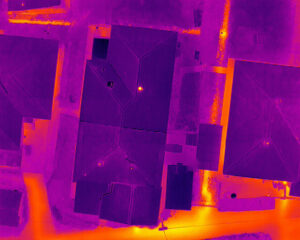 A thermal imaging camera does not see moisture directly. It sees temperature, and wet insulation holds heat differently than dry insulation does. After your roof spends a day absorbing sunlight, the wet areas release that stored heat more slowly once the sun goes down. A technician scanning your roof a few hours after sunset can see those areas as warmer spots against the surrounding dry insulation.
This process follows ASTM C1153 protocols, the standard that governs how infrared moisture surveys are conducted on roofing systems. The ASTM C1153 standard sets requirements for the equipment used, the temperature sensitivity it must achieve and the conditions under which a scan produces reliable results.
How Have Industrial Building Roof Repairs Traditionally Been Diagnosed?
Before infrared surveys became standard practice, diagnosing water intrusion in a commercial roof involved a combination of visual inspection and exploratory cuts into the membrane. A technician would walk the roof looking for obvious signs of damage, then cut small sections in areas where they suspected moisture had collected.
This approach produced two outcomes, and neither served you well. If the cuts missed the wet area, the damage kept spreading undetected under a roof that had just passed inspection. If the visible damage looked widespread, you often ended up replacing more of the roof than the actual moisture damage required, since there was no way to map the exact boundaries of the wet insulation.
Thermal imaging studies for industrial roofs solve both of these problems at once. Because the scan reveals every area holding moisture across the entire roof surface, a technician does not have to guess where to cut or rely on visible staining to know where damage has spread. You get a complete boundary of the wet insulation before any repair work begins, which lets your commercial roofing company target the actual damage instead of over-cutting or under-cutting the affected area.
How Is a Thermal Imaging Roof Study Conducted?
Thermal imaging scans are performed a few hours after sunset, once the sun-exposed dry areas of your roof have started cooling, but the wet areas are still releasing stored heat. Conducting this evaluation during the day or too late at night eliminates that temperature difference and produces unreliable results.
A technician captures the infrared images either by walking the roof surface with a handheld camera or by flying a drone equipped with thermal sensors, depending on the size and accessibility of your roof. Either method produces a thermal map showing the temperature variations across the surface.
Infrared imaging alone isn’t sufficient to confirm the areas of moisture under your roof’s surface. ASTM C1153 protocol requires verification through core sampling, where small sections of the roofing membrane are cut at the flagged locations to physically confirm wet insulation before any repair plan gets built around the scan results.
When Should You Schedule a Thermal Imaging Roof Study?
The right time for a thermal imaging study depends on your roof’s remaining life cycle and the decision you’re trying to make. In general, you may want to schedule a thermal imaging roof scan:
- Before Your Roof Warranty Expires – If your warranty is nearing its expiration date, a thermal imaging scan will document the roof’s condition while you still have the ability to file a warranty claim for any moisture damage it uncovers.
- Before Installing a New Roof Over an Existing System – Replacing your roof’s membrane without addressing any existing moisture issues keeps the water trapped underneath the surface layer of your roof, where it continues to damage the insulation and structure without any visible sign until the new roof fails too.
- When Building a Budget for Upcoming Repairs or Replacement – A thermal imaging roof scan gives you the precise square footage affected by moisture intrusion, so your roofing budget reflects the actual scope of the work instead of an estimate based on visible ceiling stains.
- After a Severe Storm – Hail and wind can compromise a membrane’s seal without leaving obvious surface damage, and a thermal imaging scan will detect water intrusion before it spreads through the insulation layer.
- As Part of Routine Preventive Maintenance on an Aging Roof – Conducting a thermal imaging study every few years once your industrial facility roof is past its midlife point will help you identify new instances of moisture intrusion before it turns into a larger repair.
Thermal Imaging Data Reduces the Cost of Roof Repairs at Your Industrial Facility
A precise moisture map lets your roofing team price a repair based on the actual affected area instead of a larger estimate built around visible damage. For example, if a scan shows moisture confined to 2,000 square feet of a 50,000 square foot roof, your repair budget reflects that 2,000 square feet rather than a broader section chosen out of caution.
Wet insulation also costs you money every day it goes undetected. Insulation loses a significant portion of its R-value once it becomes saturated, which drives up your building’s heating and cooling costs for as long as the moisture stays in place. Identifying and addressing that damage early through a thermal imaging study reduces the amount of time you experience increased energy bills. This further reduces your costs and enhances the savings associated with limiting the size of the repair area.
How to Choose a Commercial Roofing Company to Perform a Thermal Imaging Study at Your Industrial Facility
 Not every commercial roofing company performs thermal imaging studies to the same standard, and it’s important to choose a contractor who delivers the thorough, reliable data you need. Make sure you consider the following criteria when evaluating a commercial roofing company for this service:
- ASTM C1153 Compliance – Ask whether the commercial roofing company’s thermal imaging scans follow ASTM C1153 guidelines, since this confirms their equipment and timing meet the accuracy requirements the industry relies on.
- Verification Through Core Sampling – A reliable roofing company confirms the flagged areas with physical core samples before finalizing a repair recommendation based on the results.
- A Repair Plan Built Around the Scan Data – The value of a thermal imaging study comes from how your commercial roofing company uses the results. Look for a contractor that translates the moisture map directly into a scoped repair plan rather than handing you a standalone report.
HRS Commercial Roofing Can Help
HRS Commercial Roofing provides comprehensive roofing services for industrial facilities in Denver and throughout the Rocky Mountain region. Our team has the experience necessary to address all of your needs throughout your roof’s lifecycle, including all roof assessments, preventive maintenance work and full roof replacements. We utilize the latest technology and industry best practices with all services we provide. Our team is equipped to perform thermal imaging studies during your roof assessments, ensuring you receive the most precise moisture detection available.
HRS is a subsidiary of Haselden Construction, a third-generation, family-owned Colorado business serving the Denver area for over 50 years. Our affiliation with Haselden ensures you receive the exceptional quality work they’ve become known for. In addition, Haselden gives us the ability to keep all work in-house, so you’ll experience faster turnaround times, a smoother process and the most competitive pricing available.
Contact us today to schedule a roof assessment. HRS Commercial Roofing serves warehouses and industrial facilities in Denver and throughout the Rocky Mountain region.
Frequently Asked Questions About Thermal Imaging Studies for Industrial Roofs
How does thermal imaging detect moisture in a commercial roof?
A thermal imaging camera measures surface temperature rather than moisture directly. Wet insulation retains and releases heat differently than dry insulation, so scanning a few hours after sunset reveals the wet areas as warmer spots against the surrounding dry roof surface.
When should an industrial facility schedule a thermal imaging roof study?
Common triggers include a warranty nearing expiration, plans to install a new roof over an existing system, budget planning for repairs or replacement, recovery after a severe storm and routine preventive maintenance on a roof past its midlife point.
Does thermal imaging replace the need for a physical roof inspection?
No. ASTM C1153 protocol requires verification through core sampling at the flagged locations. The infrared scan identifies where to look, and the core samples confirm the moisture is actually present before a repair plan gets built around the results.
How much can thermal imaging studies reduce the cost of industrial building roof repairs?
The savings come from two sources. A precise moisture map lets you repair only the affected square footage instead of a larger area chosen out of caution, and identifying wet insulation early limits how long you pay higher energy costs from its reduced R-value.
